
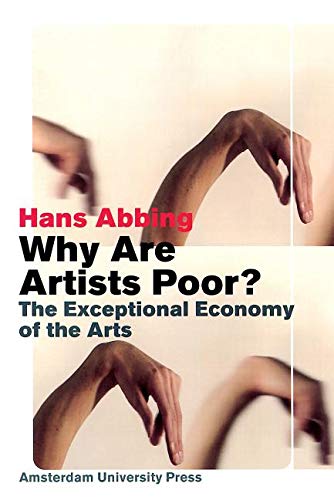
Why Are Artists Poor? : The Exceptional Economy of the Arts / Hans Abbing.
Material type: TextLanguage: English Publisher: Amsterdam : Amsterdam University Press, [2008]Copyright date: ©2002Description: 1 online resource (368 p.)Content type:
 - text
- computer
- online resource
- 9789048503650
| Cover image | Item type | Current library | Home library | Collection | Shelving location | Call number | Materials specified | Vol info | URL | Copy number | Status | Notes | Date due | Barcode | Item holds | Item hold queue priority | Course reserves | |
|---|---|---|---|---|---|---|---|---|---|---|---|---|---|---|---|---|---|---|
 E-Book
|
De Gruyter | Available |
Frontmatter -- Table of Contents -- Preface -- 1. Sacred Art: Who Has the Power to Define Art? -- 2. The Denial of the Economy: Why Are Gifts to the Arts Praised, While Market Incomes Remain Suspect? -- 3. Economic Value Versus Aesthetic Value: Is There Any Financial Reward for Quality? -- 4. The Selflessly Devoted Artist: Are Artists Reward-Oriented? -- 5. Money for the Artist: Are Artists Just Ill-Informed Gamblers? -- 6. Structural Poverty: Do Subsidies and Donations Increase Poverty? -- 7. The Cost Disease: Do Rising Costs in the Arts Make Subsidization Necessary? -- 8. The Power and the Duty to Give: Why Give to the Arts? -- 9. The Government Serves Art: Do Art Subsidies Serve the Public Interest or Group Interests? -- 10. Art Serves the Government: How Symbiotic Is the Relationship between Art and the State? -- 11. Informal Barriers Structure the Arts: How Free or Monopolized Are the Arts? -- 12. Conclusion: a Cruel Economy: Why Is the Exceptional Economy of the Arts so Persistent? -- Epilogue: the Future Economy of the Arts: Is this Book's Representation of the Economy of the Arts Outdated? -- Notes -- Literature -- Index of names -- Index of subjects
unrestricted online access star
Most artists earn very little. Nevertheless, there is no shortage of aspiring young artists. Do they give to the arts willingly or unknowingly? Governments and other institutions also give to the arts, to raise the low incomes. But their support is ineffective: subsidies only increase the artists' poverty. The economy of the arts is exceptional. Although the arts operate successfully in the marketplace, their natural affinity is with gift-giving, rather than with commercial exchange. People believe that artists are selflessly dedicated to art, that price does not reflect quality, and that the arts are free. But is it true? This unconventional multidisciplinary analysis explains the exceptional economy of the arts. Insightful illustrations from the practice of a visual artist support the analysis.
Mode of access: Internet via World Wide Web.
This eBook is made available Open Access under a CC BY-NC-ND 4.0 license:
https://creativecommons.org/licenses/by-nc-nd/4.0https://www.aup.nl/en/publish/open-access
In English.
Description based on online resource; title from PDF title page (publisher's Web site, viewed 01. Dez 2022)
There are no comments on this title.