
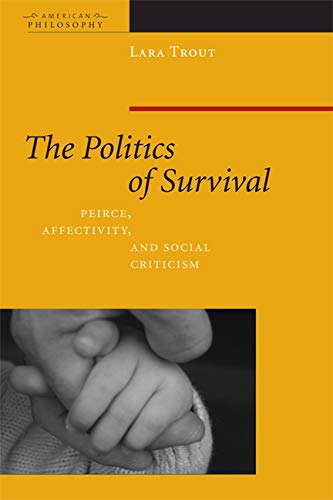
The Politics of Survival : Peirce, Affectivity, and Social Criticism / Lara Trout.
Material type: TextLanguage: English Series: American PhilosophyPublisher: New York, NY : Fordham University Press, [2019]Copyright date: ©2019Description: 1 online resource (304 p.)Content type:
 - text
- computer
- online resource
- 9780823285280
- 194 22
- B2430.R554 P36 2010
| Cover image | Item type | Current library | Home library | Collection | Shelving location | Call number | Materials specified | Vol info | URL | Copy number | Status | Notes | Date due | Barcode | Item holds | Item hold queue priority | Course reserves | |
|---|---|---|---|---|---|---|---|---|---|---|---|---|---|---|---|---|---|---|
 E-Book
|
De Gruyter | Available |
Frontmatter -- Contents -- Abbreviations -- Acknowledgments -- Introduction -- 1 Peircean Affectivity -- 2 The Affectivity of Cognition: Journal of Speculative Philosophy Cognition Series, 1868-69 -- 3 The Affectivity of Inquiry: Popular Science Monthly Illustrations of the Logic of Science Series, 1877-78 -- 4 The Law of Mind, Association, and Sympathy: Monist ''Cosmology Series'' and Association Writings, 1890s -- 5 Critical Common-sensism, 1900s -- Conclusion -- Notes -- Works Cited -- Index
unrestricted online access star
How can sincere, well-meaning people unintentionally perpetuate discrimination based on race, sex, sexuality, or other socio-political factors? To address this question, Lara Trout engages a neglected dimension of Charles S. Peirce's philosophy - human embodiment - in order to highlight the compatibility between Peirce's ideas and contemporary work in social criticism. This compatibility, which has been neglected in both Peircean and social criticism scholarship, emerges when the body is fore-grounded among the affective dimensions of Peirce's philosophy (including feeling, emotion, belief, doubt, instinct, and habit). Trout explains unintentional discrimination by situating Peircean affectivity within a post-Darwinian context, using the work of contemporary neuroscientist Antonio Damasio to facilitate this contextual move. Since children are vulnerable, naïve, and dependent upon their caretakers for survival, they must trust their caretaker's testimony about reality. This dependency, coupled with societal norms that reinforce historically dominant perspectives (such as being heterosexual, male, middle-class, and/or white), fosters the internalization of discriminatory habits that function non-consciously in adulthood. The Politics of Survival brings Peirce and social criticism into conversation. On the one hand, Peircean cognition, epistemology, phenomenology, and metaphysics dovetail with social critical insights into the inter-relationships among body and mind, emotion and reason, self and society. Moreover, Peirce's epistemological ideal of an infinitely inclusive community of inquiry into knowledge and reality implies a repudiation of exclusionary prejudice. On the other hand, work in feminism and race theory illustrates how the application of Peirce's infinitely inclusive communal ideal can be undermined by non-conscious habits of exclusion internalized in childhood by members belonging to historically dominant groups, such as the economically privileged, heterosexuals, men, and whites. Trout offers a Peircean response to this application problem that both acknowledges the "blind spots" of non-conscious discrimination and recommends a communally situated network of remedies including agapic love, critical common-sensism, scientific method, and self-control.
Mode of access: Internet via World Wide Web.
This eBook is made available Open Access under a CC BY-NC-ND 4.0 license:
https://creativecommons.org/licenses/by-nc-nd/4.0
https://www.degruyter.com/dg/page/open-access-policy
In English.
Description based on online resource; title from PDF title page (publisher's Web site, viewed 29. Jun 2022)
There are no comments on this title.