
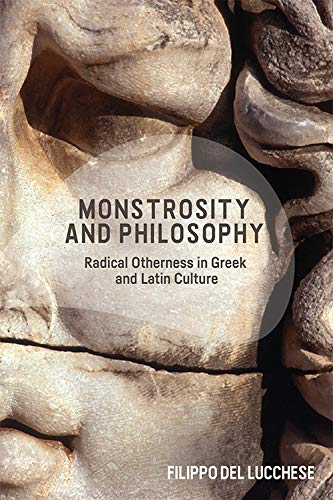
Monstrosity and Philosophy : Radical Otherness in Greek and Latin Culture / Filippo Del Lucchese.
Material type: TextLanguage: English Publisher: Edinburgh : Edinburgh University Press, [2022]Copyright date: ©2019Description: 1 online resource (432 p.)Content type:
 - text
- computer
- online resource
- 9781474456234
- B
| Cover image | Item type | Current library | Home library | Collection | Shelving location | Call number | Materials specified | Vol info | URL | Copy number | Status | Notes | Date due | Barcode | Item holds | Item hold queue priority | Course reserves | |
|---|---|---|---|---|---|---|---|---|---|---|---|---|---|---|---|---|---|---|
 E-Book
|
De Gruyter | Available |
Frontmatter -- Contents -- Acknowledgements -- Introduction -- 1 The Myth and the Logos -- 2 The Pre-Platonic Philosophers -- 3 Plato -- 4 Aristotle -- 5 Epicurus and Lucretius -- 6 Stoicism -- 7 Scepticism -- 8 Middle and Neoplatonism -- Bibliography -- Index Locorum -- Index Verborum -- Index Rerum -- Index Nominum
unrestricted online access star
Reveals monstrosity to be a central conceptual challenge in every ancient Greek and Roman philosophical systemReconstructs the concept of monstrosity in classic thought from its earliest beginnings, through pre-Platonic and Attic philosophy to the Hellenistic systems and finally arriving at NeapolitanismCovers all the major figures: from Hesiod to Augustine, through Democritus, Plato, Aristotle, Epicurus and LucretiusAddresses questions of time, causality, necessity, finality, order, justice and anomalyShows the diverse aspects of reflections on monstrosity and the problems related to its interpretationAmazons and giants, snakes and gorgons, centaurs and gryphons: monsters abounded in ancient culture. They raise enduring philosophical questions: about chaos and order; about divinity and perversion; about meaning and purpose; about the hierarchy of nature or its absence. Del Lucchese grapples with the concept of monstrosity, showing how ancient philosophers explored metaphysics, ontology, theology and politics to respond to the challenge of radical otherness in nature and in thought.Each chapter explores the emergence of monstrosity in a set of authors and theories. In chapter 1, monsters rise as the challenging adversaries of the new gods of the early cosmogonies. But they can also be powerful productive forces that support building the new order or ambiguous characters that catalyse the unfolding of the tragic universe. In chapter 2, the Pre-Platonic systems of Anaxagoras, Empedocle and Democritus pave the way for the recognition of the philosophical status of monstrosity. This status becomes central in Attic philosophy, first with Plato's mythological monstrosities and then with the construction of a hierarchical structure of the universe - taken up in chapter 3. Chapter 4 focuses on Aristotle's study of physical monstrosity and its role within his metaphysical and aetiological framework.Chapters 5-7 deal with the extraordinarily elaborate responses to Attic philosophy by the major Hellenistic systems: Epicureanism, Stoicism and Scepticism. The final chapter looks at the Middle and Neoplatonist response to Hellenism and explores the richness of late-antiquity's reflection on monstrosity up to its absorption and reworking by early Christian thought.
Mode of access: Internet via World Wide Web.
This eBook is made available Open Access under a CC BY-NC 4.0 license:
https://creativecommons.org/licenses/by-nc/4.0
https://www.degruyter.com/dg/page/open-access-policy
In English.
Description based on online resource; title from PDF title page (publisher's Web site, viewed 29. Jun 2022)
There are no comments on this title.