
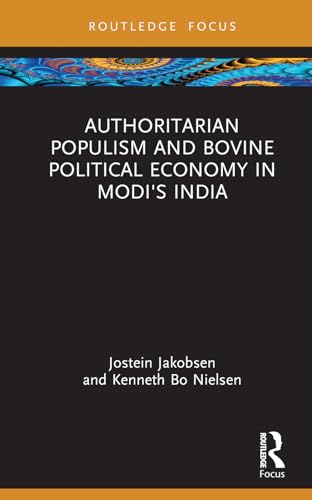
Authoritarian Populism and Bovine Political Economy in Modi's India
Material type: TextLanguage: English Series: Publication details: Oxford Taylor & Francis 2024Description: 1 online resource (112 p.)Content type:
 - text
- computer
- online resource
- 9781032709345
- 9781032709406
- 9781032709406
- 9781040003596
- 9781040003640
| Cover image | Item type | Current library | Home library | Collection | Shelving location | Call number | Materials specified | Vol info | URL | Copy number | Status | Notes | Date due | Barcode | Item holds | Item hold queue priority | Course reserves | |
|---|---|---|---|---|---|---|---|---|---|---|---|---|---|---|---|---|---|---|
 E-Book
|
Directory of Open Access Books | Available |
Unrestricted online access star
Authoritarian Populism and Bovine Political Economy in Modi's India analyses how the twin forces of Hindu nationalism and neoliberalism unfold in India's bovine economy, revealing their often-devastating material and economic impact on the country's poor. This book is a rare, in-depth study of India's bovine economy under Narendra Modi's authoritarian populism. This is an economy that throws up a central paradox: On the one hand, an entrenched and aggressive Hindu nationalist politics is engaged in violently protecting the cow, disciplining those who do not sufficiently respect and revere it; on the other hand, India houses and continuously promotes one of the world's largest corporate-controlled beef export economies that depends on the slaughter of millions of bovines every year. The book offers an original analysis of this scenario to show how Modi's authoritarian populist regime has worked to reconcile the two by simultaneously promoting a virulent Hindu nationalism that seeks to turn India into a Hindu state, while also pushing neoliberal economic policies favouring corporate capital and elite class interests within and beyond the bovine economy. The book brings out the adverse impacts of these political-economic processes on the lives and livelihoods of millions of poor Indians in countryside and city. In addition, it identifies emerging weaknesses in Modi's authoritarian populism, highlighting the potential for progressive counter-mobilisation. It will be of interest to scholars in the fields of development studies, South Asia studies, critical agrarian studies, as well as scholars with a general interest in political economy, contemporary authoritarian populism, and social movements.
Creative Commons https://creativecommons.org/licenses/by-nc-nd/4.0/legalcode cc
https://creativecommons.org/licenses/by-nc-nd/4.0/legalcode
English
There are no comments on this title.