
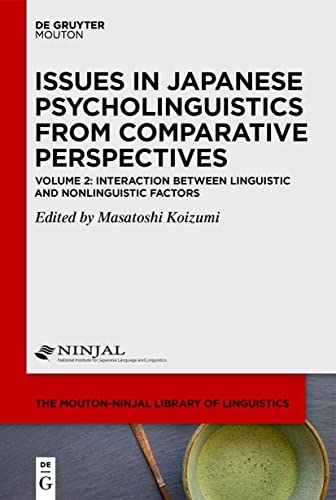
Interaction Between Linguistic and Nonlinguistic Factors
Material type: TextLanguage: English Publication details: Basel/Berlin/Boston De Gruyter 2024Description: 1 online resource (332 p.)Content type:
 - text
- computer
- online resource
- 9783110778816
- 9783110778939
- 9783110778939
- 9783110779073
| Cover image | Item type | Current library | Home library | Collection | Shelving location | Call number | Materials specified | Vol info | URL | Copy number | Status | Notes | Date due | Barcode | Item holds | Item hold queue priority | Course reserves | |
|---|---|---|---|---|---|---|---|---|---|---|---|---|---|---|---|---|---|---|
 E-Book
|
Directory of Open Access Books | Available |
Unrestricted online access star
Issues in Japanese Psycholinguistics from Comparative Perspectives compiles over 30 state-of-the-art articles on Japanese psycholinguistics. It emphasizes the importance of using comparative perspectives when conducting psycholinguistic research. Psycholinguistic studies of Japanese have contributed greatly to the field from a cross-linguistic perspective. However, the target languages for comparison have been limited. Most research focuses on English and a few other typologically similar languages. As a result, many current theories of psycholinguistics fail to acknowledge the nature of ergative-absolutive and/or object-before-subject languages. The cross-linguistic approach is not the only method of comparison in psycholinguistics. Other prominent comparative aspects include comprehension vs. production, native speakers vs. second language learners, typical vs. aphasic language development. Many of these approaches are underrepresented in Japanese psycholinguistics. The studies reported in the volumes attempt to bridge these gaps. Using various experimental and/or computational methods, they address issues of the universality/diversity of the human language and the nature of the relationship between human cognitive modules. Volume 2, Interaction Between Linguistic and Nonlinguistic Factors, provides studies on the interaction between linguistic and non-linguistic factors. ; Issues in Japanese Psycholinguistics from Comparative Perspectives compiles over 30 state-of-the-art articles on Japanese psycholinguistics. It emphasizes the importance of using comparative perspectives when conducting psycholinguistic research. Psycholinguistic studies of Japanese have contributed greatly to the field from a cross-linguistic perspective. However, the target languages for comparison have been limited. Most research focuses on English and a few other typologically similar languages. As a result, many current theories of psycholinguistics fail to acknowledge the nature of ergative-absolutive and/or object-before-subject languages. The cross-linguistic approach is not the only method of comparison in psycholinguistics. Other prominent comparative aspects include comprehension vs. production, native speakers vs. second language learners, typical vs. aphasic language development. Many of these approaches are underrepresented in Japanese psycholinguistics. The studies reported in the volumes attempt to bridge these gaps. Using various experimental and/or computational methods, they address issues of the universality/diversity of the human language and the nature of the relationship between human cognitive modules. Volume 2, Interaction Between Linguistic and Nonlinguistic Factors, provides studies on the interaction between linguistic and non-linguistic factors.
Creative Commons by-nc-nd/4.0 cc
http://creativecommons.org/licenses/by-nc-nd/4.0
English
There are no comments on this title.