
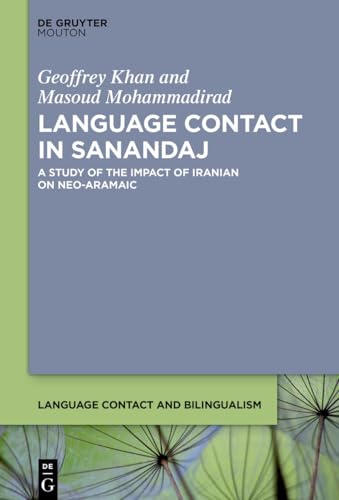
Language Contact in Sanandaj A Study of the Impact of Iranian on Neo-Aramaic
Material type: TextLanguage: English Series: Publication details: Basel/Berlin/Boston De Gruyter 2024Description: 1 online resource (614 p.)Content type:
 - text
- computer
- online resource
- 9783111205786
- 9783111209180
- 9783111209180
- 9783111210070
| Cover image | Item type | Current library | Home library | Collection | Shelving location | Call number | Materials specified | Vol info | URL | Copy number | Status | Notes | Date due | Barcode | Item holds | Item hold queue priority | Course reserves | |
|---|---|---|---|---|---|---|---|---|---|---|---|---|---|---|---|---|---|---|
 E-Book
|
Directory of Open Access Books | Available |
Unrestricted online access star
This book is a detailed study of contact-induced change in the Neo-Aramaic dialect of the Jews of Sanandaj, a town in western Iran. Since its foundation in early 17th century, the city has been home to a significant Jewish community. The Jewish Neo-Aramaic dialect of the town displays different historical layers of contact with various Iranian languages over the course of many centuries. The Iranian languages in question are Gorani, Kurdish, and Persian. Among these, Gorani has had a particularly deep impact on Jewish Neo-Aramaic, whereas the impact of Kurdish, and especially Persian, remains superficial. Jewish Neo-Aramaic records a history of language shift from Gorani to Kurdish in the region. The book offers insights into contact-induced change in social contexts in which a language is maintained as a demarcation of communal identity in a multilingual setting. ; This book is a detailed study of contact-induced change in the Neo-Aramaic dialect of the Jews of Sanandaj, a town in western Iran. Since its foundation in early 17th century, the city has been home to a significant Jewish community. The Jewish Neo-Aramaic dialect of the town displays different historical layers of contact with various Iranian languages over the course of many centuries. The Iranian languages in question are Gorani, Kurdish, and Persian. Among these, Gorani has had a particularly deep impact on Jewish Neo-Aramaic, whereas the impact of Kurdish, and especially Persian, remains superficial. Jewish Neo-Aramaic records a history of language shift from Gorani to Kurdish in the region. The book offers insights into contact-induced change in social contexts in which a language is maintained as a demarcation of communal identity in a multilingual setting.
Creative Commons by-nc-nd/4.0 cc
http://creativecommons.org/licenses/by-nc-nd/4.0
English
There are no comments on this title.