
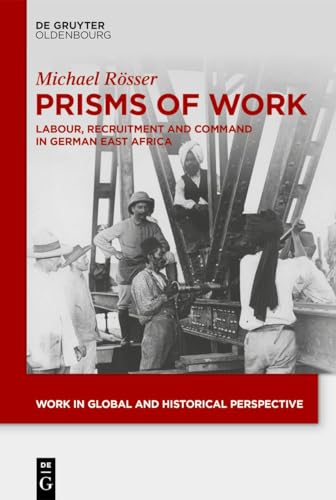
Prisms of Work Labour, Recruitment and Command in German East Africa
Material type: TextLanguage: English Series: Publication details: Basel/Berlin/Boston De Gruyter 2024Description: 1 online resource (421 p.)Content type:
 - text
- computer
- online resource
- 9783111204628
- 9783111218090
- 9783111218090
- 9783111218960
| Cover image | Item type | Current library | Home library | Collection | Shelving location | Call number | Materials specified | Vol info | URL | Copy number | Status | Notes | Date due | Barcode | Item holds | Item hold queue priority | Course reserves | |
|---|---|---|---|---|---|---|---|---|---|---|---|---|---|---|---|---|---|---|
 E-Book
|
Directory of Open Access Books | Available |
Unrestricted online access star
The phenomenon of labour takes the character of a prism. Labour is thereby always context dependent and constituted through the actions of all protagonists involved in any labour relationship. On the basis of three case studies in colonial German East Africa - the construction of the Central Railway (1905-1916), the Otto Plantation in Kilossa (1907-1916) and the palaeontological Tendaguru Expedition (1909-1911) - labour and labour relations are analysed. The focus lies on hitherto neglected actors and groups of actors of labour in the colonial context of East Africa. These were especially German companies and their staff, white subaltern railway sub-contractors and labour recruiters, Indian skilled workers and (qualified) East African workers. Furthermore, all three sites of labour proved to have their individual logics and characteristics. But all of them were in tension between the 'global' and the 'local', coercion and voluntariness, machine and manual labour, skilled and unskilled labour, reproductive and wage labour, as well as between black and white. Michael Rösser's dissertation has been awarded with 'honorary distinction' by the European Network in Universal and Global History (ENIUGH). ; The phenomenon of labour takes the character of a prism. Labour is thereby always context dependent and constituted through the actions of all protagonists involved in any labour relationship. On the basis of three case studies in colonial German East Africa - the construction of the Central Railway (1905-1916), the Otto Plantation in Kilossa (1907-1916) and the palaeontological Tendaguru Expedition (1909-1911) - labour and labour relations are analysed. The focus lies on hitherto neglected actors and groups of actors of labour in the colonial context of East Africa. These were especially German companies and their staff, white subaltern railway sub-contractors and labour recruiters, Indian skilled workers and (qualified) East African workers. Furthermore, all three sites of labour proved to have their individual logics and characteristics. But all of them were in tension between the 'global' and the 'local', coercion and voluntariness, machine and manual labour, skilled and unskilled labour, reproductive and wage labour, as well as between black and white. Michael Rösser's dissertation has been awarded with 'honorary distinction' by the European Network in Universal and Global History (ENIUGH).
Creative Commons by/4.0 cc
http://creativecommons.org/licenses/by/4.0
English
There are no comments on this title.