
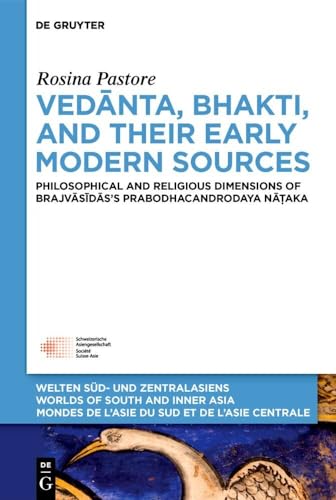
Vedānta, Bhakti, and Their Early Modern Sources Philosophical and Religious Dimensions of Brajvāsīdās's Prabodhacandrodaya Nāṭaka
Material type: TextLanguage: English Series: Publication details: Berlin/Boston De Gruyter 2024Description: 1 online resource (374 p.)Content type:
 - text
- computer
- online resource
- 9783111063188
- 9783111063836
- 9783111063836
- 9783111064314
| Cover image | Item type | Current library | Home library | Collection | Shelving location | Call number | Materials specified | Vol info | URL | Copy number | Status | Notes | Date due | Barcode | Item holds | Item hold queue priority | Course reserves | |
|---|---|---|---|---|---|---|---|---|---|---|---|---|---|---|---|---|---|---|
 E-Book
|
Directory of Open Access Books | Available |
Unrestricted online access star
This volume considers the Prabodhacandrodaya Nāṭaka (c. 1760 CE), an allegorical drama composed by Brajvāsīdās in Brajbhāṣā. It contributes to the study of vernacular nāṭakas with its first complete English translation. Moreover, the critical analysis shows that the foundational Sanskrit texts for Vedānta and those for Bhakti play a part in the Prabodhacandrodaya Nāṭaka's philosophical and religious edifice. At the same time, the investigation demonstrates that Brajvāsīdās expresses several philosophical ideas by adaptively reusing the Rāmcaritmānas by Tulsīdās (c. 1574 CE). Brajvāsīdās composes a dohā by combining one line of his invention with a line from the Mānas. This method is employed throughout all the personified metaphysical concepts. That Brajvāsī not only read Bhakti but also Vedānta through the Rāmcaritmānas highlights the philosophical and literary creativity in 18th c. North India. It points to the necessity to rethink the sources of Vedānta philosophies, by including works non-conventional for language and genre, because not in Sanskrit and not śāstras. Such sources may not be original in their contribution per se but are essential to understand how early modern philosophy was done, conceived and transmitted. ; This volume considers the Prabodhacandrodaya Nāṭaka (c. 1760 CE), an allegorical drama composed by Brajvāsīdās in Brajbhāṣā. It contributes to the study of vernacular nāṭakas with its first complete English translation. Moreover, the critical analysis shows that the foundational Sanskrit texts for Vedānta and those for Bhakti play a part in the Prabodhacandrodaya Nāṭaka's philosophical and religious edifice. At the same time, the investigation demonstrates that Brajvāsīdās expresses several philosophical ideas by adaptively reusing the Rāmcaritmānas by Tulsīdās (c. 1574 CE). Brajvāsīdās composes a dohā by combining one line of his invention with a line from the Mānas. This method is employed throughout all the personified metaphysical concepts. That Brajvāsī not only read Bhakti but also Vedānta through the Rāmcaritmānas highlights the philosophical and literary creativity in 18th c. North India. It points to the necessity to rethink the sources of Vedānta philosophies, by including works non-conventional for language and genre, because not in Sanskrit and not śāstras. Such sources may not be original in their contribution per se but are essential to understand how early modern philosophy was done, conceived and transmitted.
Schweizerischer Nationalfonds zur Förderung der Wissenschaftlichen Forschung
Creative Commons by-nc-nd/4.0 cc
http://creativecommons.org/licenses/by-nc-nd/4.0
English
There are no comments on this title.