
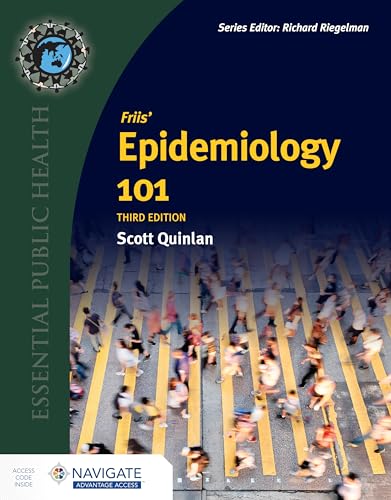
Friis' epidemiology 101 / [editor] Scott C. Quinlan, PhD., MS.
Material type: TextSeries: Essential public healthPublisher: Burlington, Massachusetts : Jones & Bartlett Learning, ©2025Edition: Third editionDescription: xix, 264 pages : color illustrations ; 28 cmContent type:
 - text
- unmediated
- volume
- 978-1-28422-909-7
- Friis' Epidemiology one hundred and one
- Friis' Epidemiology one hundred one
- Epidemiology one hundred and one
- Epidemiology one hundred one
- 614.4
- RA651 .F916 2025
- EDU000000
| Cover image | Item type | Current library | Home library | Collection | Shelving location | Call number | Materials specified | Vol info | URL | Copy number | Status | Notes | Date due | Barcode | Item holds | Item hold queue priority | Course reserves | |
|---|---|---|---|---|---|---|---|---|---|---|---|---|---|---|---|---|---|---|
 Reserved Books
|
Taytay College Library Medicine Collection | Non-fiction | RA651 .F916 2025 (Browse shelf(Opens below)) | 1 | Available | URSTAY-6093 |
Includes bibliographical references and index.
"Epidemiology 101 is designed for undergraduate students who have little to no prior experience with health-related fields or statistics. The text was written in response to a growing need for epidemiological content in undergraduate programs and curricula, specifically as a liberal arts subject, and emphasizes socially related determinants of health and health disparities relevant. This text fulfills this need by presenting key concepts of epidemiology in a clear and precise way and uses learning objectives and study questions that make topics accessible to students who have an interest in epidemiology. The text encourages problem analysis, deductive and inductive reasoning, and applying generalizations to a larger context, all of which are key skills used in epidemiology"-- Provided by publisher.
"In the wake of the COVID-19 pandemic, the MPox epidemic, recent outbreaks of Ebola, and a growing focus on the role of social determinants in health disparities, and more, there is increasing motivation and need to learn about epidemiology.Friis' Epidemiology 101, Third Edition is a clear and accessible resource designed to provide students with a solid foundation in basic epidemiologic concepts while also demonstrating how these concepts can be applied to problems in everyday life. In keeping with the prior editions, this non-technical text is written for students with little or background in health and biostatistics, and offers numerous case studies, text boxes, vignettes, exhibits, photographs, figures, and illustrations to engage readers.Key Features Updated throughout with new data and examples. Coverage of the COVID-19 pandemic, mPox, the drug overdose epidemic, and an enhanced understanding of the social determinants of health. Additional discussion of epidemiology applications including chronic disease epidemiology and epidemiology of aging. A streamlined and reorganized introduction to study designs. Practice problems at the end of each chapter give students the opportunity to apply the skills that they're learning"-- Provided by publisher.
There are no comments on this title.