
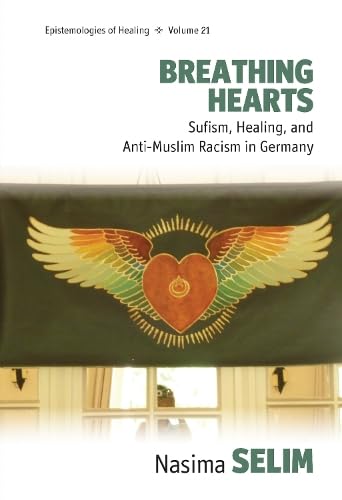
Breathing Hearts : Sufism, Healing, and Anti-Muslim Racism in Germany / Nasima Selim.
Material type: TextSeries: Epistemologies of healing ; v. 21.Publisher: New York : Berghahn Books, 2024Copyright date: ©2024Description: 1 online resource (xviii, 260 pages) : illustrations, mapContent type:
 - text
- computer
- online resource
- 9781805392002
- 180539200X
- 1805392360
- 9781805392361
- 1805391984
- 9781805391982
- BP189.65.F35 S45 2024
- BP188.8.G3
| Cover image | Item type | Current library | Home library | Collection | Shelving location | Call number | Materials specified | Vol info | URL | Copy number | Status | Notes | Date due | Barcode | Item holds | Item hold queue priority | Course reserves | |
|---|---|---|---|---|---|---|---|---|---|---|---|---|---|---|---|---|---|---|
 E-Book
|
JSTOR Open Access Books | Not For Loan |
Includes bibliographical references and index.
Intro -- Contents -- Illustrations -- Preface -- The Ethnographer Breathes -- Acknowledgments -- Note on Transliteration and Translation -- Abbreviations -- Introduction -- "A Sufi Is Someone Who Breathes Well": The Ways of Breathing Hearts -- Chapter 1 -- The Unseen Neighbors and a Dual Apprentice: Silsila, or Drawing the Lines of Transmitting Breath -- Chapter 2 -- "Why Do I Suffer and What Should I Do?": The Desire Lines of Sufi Breathing-Becoming -- Chapter 3 -- Techniques of Transformation: Subtle-Material Bodies in Dhikr and Other (Breathing) Practices
Chapter 4 -- "There Must Be Something Else": The In-between World of Healing Secular and Religious Suffering -- Chapter 5 -- Participation in the Real: The Healing Power of Breath, Words, and Things -- Chapter 6 -- "The Right-Wing Attacks Our Mosques and Our Muslim Brothers Do Not Consider Us to Be Real Muslims!": The (Anti-)Politics of Breathing Hearts -- Conclusion -- Lessons from the Breathing, Wayfaring Hearts -- Epilogue -- Sufi Breathing In the Pandemic Ruins of (Anti-Muslim) Racism -- Glossary -- References -- Index
Sufism is known as the mystical dimension of Islam. Breathing Hearts explores this definition to find out what it means to 'breathe well' along the Sufi path in the context of anti-Muslim racism. It is the first book-length ethnographic account of Sufi practices and politics in Berlin and describes how Sufi practices are mobilized in healing secular and religious suffering. It tracks the Desire Lines of multi-ethnic immigrants of color, and white German interlocutors to show how Sufi practices complicate the post secular imagination of healing in Germany.
Description based on online resource; title from digital title page (viewed on February 08, 2024).
JSTOR Books at JSTOR Open Access
There are no comments on this title.