
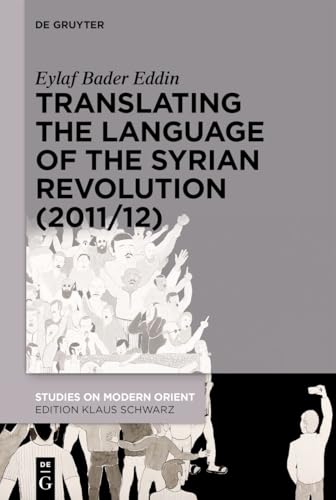
Translating the Language of the Syrian Revolution (2011/12)
Material type: TextLanguage: English Series: Publication details: Berlin/Boston De Gruyter 2024Description: 1 online resource (293 p.)Content type:
 - text
- computer
- online resource
- 9783110766653
- 9783110767698
- 9783110767698
- 9783110767742
| Cover image | Item type | Current library | Home library | Collection | Shelving location | Call number | Materials specified | Vol info | URL | Copy number | Status | Notes | Date due | Barcode | Item holds | Item hold queue priority | Course reserves | |
|---|---|---|---|---|---|---|---|---|---|---|---|---|---|---|---|---|---|---|
 E-Book
|
Directory of Open Access Books | Available |
Unrestricted online access star
While the Arab revolutions have obviously triggered extensive social and political changes, the far-reaching consequences of the cultural and discursive changes have yet to be adequately considered. For activists, researchers, and journalists, the revolution was primarily a revolution in language; a break with the linguistic oppression and the rigidity of the old regimes. This break was accompanied by the emergence of new languages, which made it possible to inform, tell, and translate the ongoing events and transformations. This language of the revolution was carried out into the world by competing voices from Syria (by local and foreign researchers, activists, and journalists). The core of this project is to find the various translations of the language of the Syrian revolution (2011-2012) from Arabic to English to study and analyze. In addition, the discursive and non-discursive dimensions of the revolution are to be seen as another act of translation, including the language of the banners, slogans, graffiti, songs, and their representation in English. ; While the Arab revolutions have obviously triggered extensive social and political changes, the far-reaching consequences of the cultural and discursive changes have yet to be adequately considered. For activists, researchers, and journalists, the revolution was primarily a revolution in language; a break with the linguistic oppression and the rigidity of the old regimes. This break was accompanied by the emergence of new languages, which made it possible to inform, tell, and translate the ongoing events and transformations. This language of the revolution was carried out into the world by competing voices from Syria (by local and foreign researchers, activists, and journalists). The core of this project is to find the various translations of the language of the Syrian revolution (2011-2012) from Arabic to English to study and analyze. In addition, the discursive and non-discursive dimensions of the revolution are to be seen as another act of translation, including the language of the banners, slogans, graffiti, songs, and their representation in English.
Creative Commons by-nc-nd/4.0 cc
http://creativecommons.org/licenses/by-nc-nd/4.0
English
There are no comments on this title.